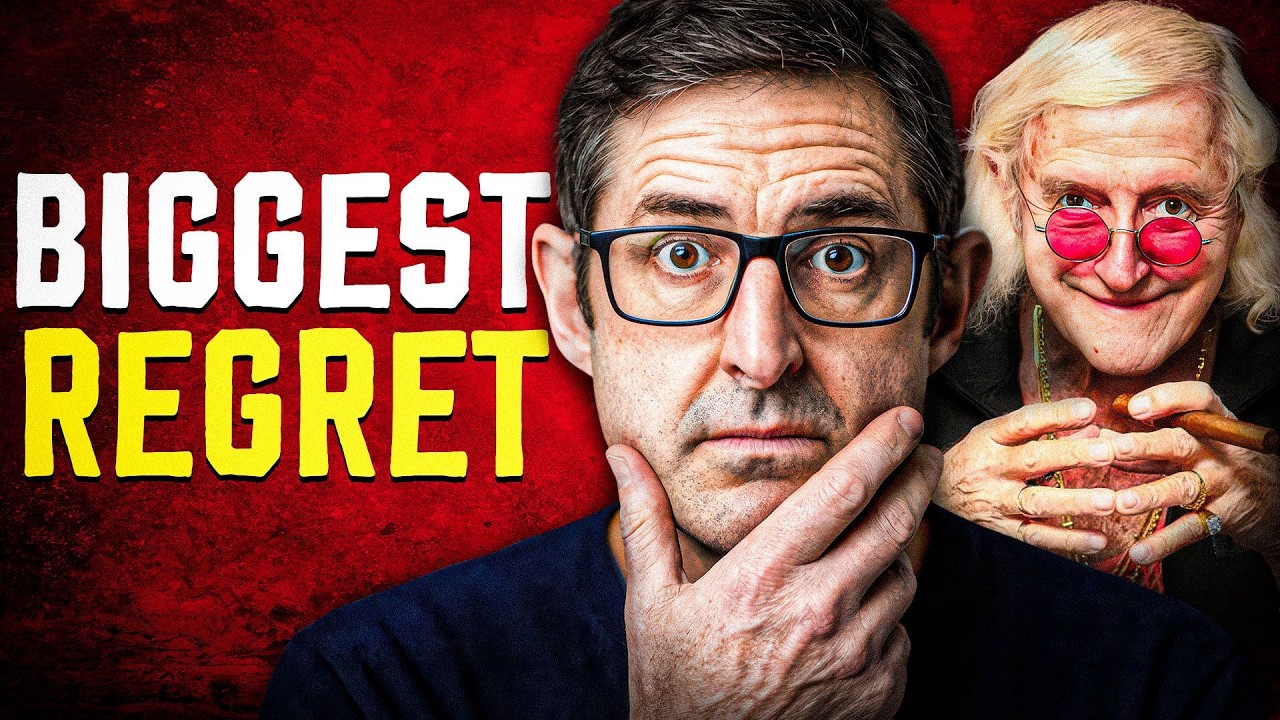
The year 2000 was a different era for British television. It was a time when eccentricity was celebrated, and national treasures were held in a regard that bordered on the sacred. At the center of this cultural landscape was Jimmy Savile, a man who seemed to belong to everyone. When Louis Theroux, then a rising star of the documentary world, sat down to film “When Louis Met Jimmy,” the resulting footage was seen as a quirky, slightly awkward, and ultimately fascinating look at a bizarre public figure.
Fast forward to the present day, and that same footage has been transformed into a chilling artifact of missed opportunities and hidden-in-plain-sight predation. A recent deep dive by the Terry Stone Connection has brought this controversy back to the forefront, examining how one of the world’s most talented investigative journalists found himself in the orbit of a monster, and why the warning signs were so difficult to decode at the time.
The Cultural Shield of a National Treasure
To understand why Louis Theroux’s documentary went “horribly wrong” in the eyes of history, one must first understand the power Jimmy Savile wielded. He was not just a television presenter; he was a philanthropist who had raised millions for charity, a friend to the Royal Family, and a man who held the keys to hospitals and prisons across the UK.
As noted in the Terry Stone Connection analysis, Savile utilized this “sainthood” as a tactical shield. When Louis entered Savile’s world, he was entering a space where Savile set the rules. The documentary shows Savile as a man of strange habits and circular logic, but at the time, the audience interpreted this as the “eccentricity” of a genius. Looking back through a modern lens, however, that eccentricity looks like a carefully constructed wall designed to keep investigators at arm’s length.
Decoding the Warning Signs in Plain Sight
One of the most uncomfortable aspects of revisiting this documentary is seeing the moments where Savile almost tells on himself. Terry Stone’s deep dive highlights several sequences that feel entirely different with the benefit of hindsight. There are moments where Savile discusses his need for control, his lack of traditional emotional ties, and his “rules” for the people around him.
There is a specific sequence where Savile boasts about the brutal way he handled “troublemakers” at the nightclubs he ran in Leeds. At the time, this was framed as a tough-guy persona from a bygone era of nightlife. Today, it serves as a terrifying glimpse into a man who viewed himself as above the law and capable of silencing anyone who crossed him. The Terry Stone Connection emphasizes that these weren’t just “creepy” moments; they were glimpses of the predatory mechanics that allowed him to operate for decades.
The Relationship Between Interviewer and Subject
A central question posed by the Terry Stone Connection is whether Louis Theroux got too close to his subject. Theroux is famous for his “disarming” style, a technique where he plays the role of the naive outsider to encourage his subjects to lower their guard. With Savile, this dynamic created a strange, almost friendly rapport.
Theroux himself has admitted in the years since that he felt he had formed “something like a friendship” with Savile after the cameras stopped rolling. This is the ultimate trap for a documentary filmmaker. When you begin to like your subject, your instinct to interrogate their darkest corners can be dulled. The Terry Stone analysis explores whether Louis was misled like the rest of the nation, or if the very style that made him great at his job was the thing that allowed Savile to slip through his fingers.
The Psychological Manipulation of the Media
Jimmy Savile was a master of the “hiding in plain sight” technique. He often joked about his dark reputation, making light of rumors in a way that made anyone who took them seriously look like a conspiracy theorist. By leaning into the “creepy” persona, he effectively neutralized it.
The Terry Stone Connection points out that the documentary captures Savile’s circular way of speaking, which was designed to exhaust the interviewer. Whenever Louis pushed for a real answer about Savile’s private life or his past, Savile would pivot to a joke, a nonsensical anecdote, or a reference to his charitable work. It was a masterclass in media manipulation. The blog post explains that this wasn’t just Savile being “difficult”; it was a survival strategy for a man who knew that if he ever stopped talking, people might start looking.
Why the Terry Stone Deep Dive Matters Today
Why are we still talking about a documentary from 25 years ago? The Terry Stone Connection suggests that it is because the Savile case represents the ultimate failure of institutional and media accountability. By breaking down the moments that were asked and the questions that weren’t, we learn how to better protect the vulnerable in the future.
The deep dive isn’t just a critique of Louis Theroux; it is an autopsy of a cultural blind spot. It asks us to consider how many other “national treasures” are currently hiding behind the same shields of charity, celebrity, and eccentricity. The Terry Stone Connection reminds its audience that the “warning signs” are rarely a smoking gun; they are usually a series of small, uncomfortable moments that we choose to ignore because the truth is too difficult to process.
The Burden of Hindsight and the Path Forward
Louis Theroux has been remarkably candid about his regrets regarding the Savile documentary. He later produced a follow-up film, “Louis Theroux: Savile,” where he met with victims and confronted his own guilt. This willingness to revisit his failure is part of what makes Theroux a respected figure today, but it doesn’t erase the impact of the original film.
The Terry Stone Connection’s analysis serves as a vital reminder that the media has a responsibility that goes beyond entertainment. When we treat “creepy” behavior as a quirk for the sake of a good story, we risk becoming complicit in the silence that allows predators to thrive.
Conclusion: Lessons from a Darker Side of History
Looking back at “When Louis Met Jimmy” is a sobering experience. It is a documentary that has aged in the darkest way possible, transforming from a character study into a crime scene. Through the lens of the Terry Stone Connection, we can see that the “horrible” turn of the documentary wasn’t a result of bad filmmaking, but a result of a society that was not yet ready to believe the truth.
As we move forward in an era of “true crime” obsession and deep-dive investigations, let this documentary serve as the ultimate cautionary tale. Celebrity is a powerful mask, and hindsight is a heavy burden. The goal of modern media should be to ensure that the next time a monster hides in plain sight, we don’t wait twenty years to see them for what they really are. By studying the mistakes of the past, we can hope to build a future where the warning signs are never ignored again.