There are not many British actors with a career quite like Danny Dyer.
He has been a rave culture icon, a football hooligan, a gangster film regular, the landlord of the Queen Vic, a documentary presenter, a game show host and, eventually, a BAFTA-winning actor.
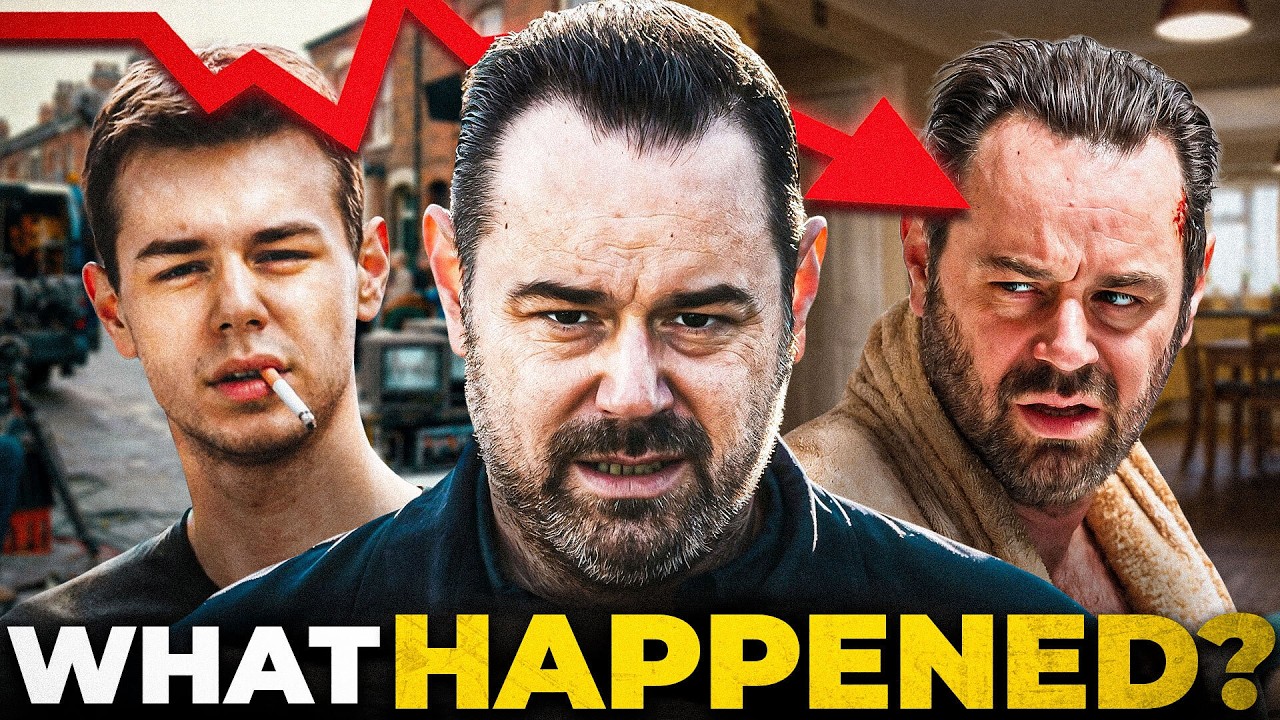
Yet perhaps the most interesting part of Danny Dyer’s career is not simply the number of roles he has played. It is how many times the public perception of him has changed.
For years, Dyer appeared trapped by the very image that had made him famous. Today, he has emerged from that period as one of the most recognisable and popular personalities on British television.
His story is one of talent, typecasting, class, public perception and a remarkable ability to reinvent himself.
Danny Dyer’s Early Acting Career
Born Daniel John Dyer in Custom House, East London in 1977, Dyer’s background has always been a fundamental part of his public identity.
His accent, humour, slang and bluntness were never manufactured for television. They were part of who he was, and that authenticity would ultimately become both one of his greatest strengths and one of the things that threatened to restrict his acting career.
His first major television break came while he was still a teenager, appearing in Prime Suspect 3 alongside Helen Mirren.
It was an early indication that underneath the personality audiences would later associate with Dyer was a naturally talented actor capable of holding his own in serious drama.
Then, in 1999, came Human Traffic.
Playing Moff in the cult film about clubbing, friendships and weekend excess introduced Danny Dyer to an entirely new generation. The film captured late 1990s British youth culture, and Dyer fitted naturally into its chaotic world.
From Human Traffic to The Football Factory
An important part of Danny Dyer’s early career is sometimes forgotten.
He also worked closely with legendary playwright Harold Pinter, including appearing in Celebration at the Almeida Theatre before the production transferred to New York.
Pinter became far more than simply somebody Dyer worked with. He was a mentor and father figure whose belief in him demonstrated that serious theatre figures recognised Dyer’s talent long before his later hard-man reputation began to dominate his career.
However, it was 2004’s The Football Factory that would transform Dyer’s public image.
Playing Tommy Johnson made him synonymous with a particular era of British cinema built around football, masculinity, drinking, drugs, violence and working-class culture.
The success of The Football Factory was followed by films including The Business, further cementing Dyer as one of the first actors producers considered when casting British crime and hooligan films.
That success came with a problem.
Danny Dyer was becoming a brand.
How Danny Dyer Became Typecast
By the mid 2000s, audiences knew exactly what they expected from a Danny Dyer film.
Cockney accent. Swagger. Violence. Pubs. Football. Trouble.
Dyer was successful and consistently working, but the industry increasingly appeared to see him as only one type of performer.
He has spoken openly about feeling that his working-class background and accent affected how seriously parts of the industry regarded him. He also acknowledged that there was a period when he became something of a parody of himself.
Television documentaries such as The Real Football Factories blurred the line even further.
Dyer was no longer simply playing characters connected with violence, football firms and criminality. He was presenting programmes about those subjects as himself.
The distinction between Danny Dyer the actor and Danny Dyer the public persona was disappearing.
The Difficult Years of Danny Dyer’s Career
By the late 2000s and early 2010s, the formula was beginning to wear thin.
A succession of low-budget films continued to use variations of the same Danny Dyer character, while several projects were badly received by critics.
Pimp, released in 2010, was heavily criticised. Then came Run for Your Wife in 2013, which suffered an extraordinarily poor critical and commercial reception.
At the same time, Dyer had become an easy target for parts of the British media.
He remained famous and had a loyal audience, but the persona that had originally made him successful increasingly appeared to be limiting where his career could go next.
Then everything changed.
EastEnders and the Reinvention of Danny Dyer
In 2013, Danny Dyer joined EastEnders as Mick Carter, the new landlord of the Queen Vic.
It proved to be one of the most important roles of his career.
The obvious option would have been to make Mick Carter another aggressive East End hard man. Instead, viewers were introduced to a much more rounded character.
Mick could be tough, but he was also funny, protective, vulnerable and emotionally open.
His relationship with Linda Carter, played by Kellie Bright, became central to the show, while storylines involving his family allowed Dyer to demonstrate significantly more range than many critics had previously given him credit for.
Suddenly, millions of viewers were seeing a different Danny Dyer.
The turnaround was dramatic. He won National Television Awards for Serial Drama Performance in 2015, 2016 and 2019, while Dyer himself later acknowledged just how important EastEnders had been in rebuilding his career.
Life After EastEnders
After almost nine years playing Mick Carter, Dyer left EastEnders in 2022.
It was another major gamble.
After spending so long playing one of Britain’s best-known soap characters, there was a danger of being typecast all over again.
Instead of simply returning to the roles audiences expected, Dyer began choosing projects that played with his established image.
In Sky comedy Mr Bigstuff, he could still be loud, chaotic and unmistakably Danny Dyer, but there was more vulnerability beneath the surface.
Then came Disney+ drama Rivals, where Dyer played self-made electronics millionaire Freddie Jones.
Placed amongst the wealthy and status-conscious world of the series, Freddie’s blunt honesty made him stand out. More surprisingly, the former Football Factory hard man found himself being discussed as something of a romantic lead and, eventually, an unlikely national treasure.
Danny Dyer’s BAFTA Win and Latest Comeback
The ultimate validation arrived in 2025 when Danny Dyer won the BAFTA Television Award for Male Performance in a Comedy for Mr Bigstuff.
For an actor who had spent years being dismissed by some critics as little more than a caricature, the award represented something bigger than another successful television role.
It represented recognition.
At the same time, Dyer reunited with director Nick Love for Marching Powder, returning to the football, masculinity and chaos that defined some of his best-known earlier work.
But this time the perspective was different.
Dyer was older. His audience was older. The characters could no longer behave like they were 25 without consequences.
The swagger remained, but now there was baggage attached to it.
Why Danny Dyer’s Career Has Endured
Danny Dyer’s career has never followed the polished path expected of a conventional British acting star.
That may be exactly why it has lasted.
He has been celebrated, typecast, criticised, mocked, reinvented and finally recognised by the same industry that once seemed unsure what to do with him.
From Human Traffic and The Football Factory to Mick Carter, Mr Bigstuff and Rivals, every stage of Danny Dyer’s career has carried something from the one before it.
He never needed to completely abandon the Danny Dyer audiences already knew.
He simply needed the opportunity to show there was more to him.
That is what makes his comeback so compelling. Danny Dyer did not become successful again by transforming himself into somebody else.
He became successful again by finally being allowed to be Danny Dyer without being limited by what people thought that meant.